
8 Key Assistant Restaurant Manager Job Responsibilities for 2026
· Thibault Le Conte
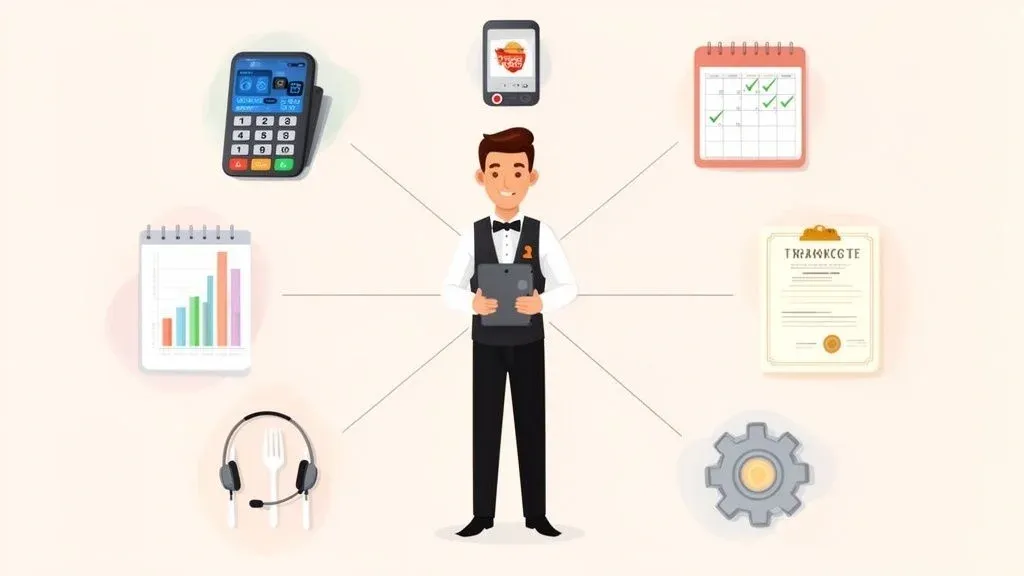
The role of an assistant restaurant manager has evolved far beyond traditional duties like managing floor staff and closing registers. In today’s competitive market, shaped by online ordering and third-party delivery apps, the most effective assistant managers are tech-focused operational hubs. They are the critical link ensuring that the influx of multi-channel orders-from Uber Eats, DoorDash, and dine-in guests-is translated into smooth, efficient, and profitable kitchen execution. This is a significant shift in assistant restaurant manager job responsibilities, demanding a new set of skills centered on technology and data.
This guide breaks down the eight core assistant restaurant manager job responsibilities, reframed for the modern restaurant. We’ll move beyond the generic job description and provide actionable insights on how to excel in each area. A key focus will be on how direct Point-of-Sale (POS) integration, like connecting delivery platforms to systems such as Clover or Square, is no longer an optional skill but an essential component of the job. For restaurant owners, this is your blueprint for hiring and training a high-impact assistant manager who can directly drive efficiency, reduce costly order errors, and boost your bottom line. Readers will learn how to:
- Master multi-channel order flow from delivery apps and in-house systems.
- Control inventory and food costs with data from integrated platforms.
- Optimize staff schedules based on real-time order volume and trends.
- Manage delivery partner relationships to improve performance and profitability.
This article provides the practical steps needed to turn an assistant manager into a true operational leader who actively contributes to growth.
1. Managing Restaurant Delivery & POS Integration
One of the most critical modern assistant restaurant manager job responsibilities is overseeing the technological hub of the business: its ordering system. Today’s restaurants juggle walk-ins, phone calls, and a constant stream of orders from third-party delivery apps like Uber Eats and DoorDash. In simple terms, this means managing a lot of different orders coming from different places all at once. Without a unified system, staff must manually re-enter each digital order into the Point of Sale (POS), a process that invites costly errors and delays.
An assistant manager is responsible for ensuring this entire ecosystem works smoothly. Technically, this involves managing the POS integration of all ordering channels into one central system, preventing what’s often called “tablet hell.” With a consolidated platform like OrderOut, which integrates directly with POS systems like Clover and Square, orders from every platform appear directly on one screen. This eliminates manual entry, which can cut order errors by over 95%, and ensures the kitchen receives orders instantly and accurately. Why it matters: This directly improves restaurant efficiency and delivery speed, reducing food waste from mistakes and saving significant staff time.
The Impact of Order Integration in Practice
Consider a busy New York pizza shop that was swamped by tablets from three different delivery apps. Its staff took nearly five minutes to manually process each online order. After implementing POS integration with a tool like OrderOut, that time dropped to under one minute. This allowed them to handle a higher volume of orders from Uber Eats and DoorDash during peak rushes, boosting revenue without adding staff. The reduction in manual entry also slashed their order error rate, saving money on remade food and improving customer satisfaction. This is a clear example of how food tech enhances restaurant operations.
Key Insight: Effective order integration is no longer a luxury; it is a core component of modern restaurant operations. The assistant manager’s role is to own this process, transforming a point of potential chaos into a source of efficiency and growth.
Actionable Tips for Assistant Managers
To master this responsibility, an assistant manager should implement a consistent routine:
- Daily Audits: Start each shift by reviewing the previous day’s order accuracy rates. Check for discrepancies between the delivery apps and the POS reports.
- Staff Training: Ensure all kitchen and front-of-house staff understand how to read the consolidated digital order tickets. Run drills on how to handle special requests or order modifications that come through the system.
- System Monitoring: Set up alerts for order spikes during peak hours to anticipate kitchen load. Regularly check the status pages of your delivery platforms for any announced API changes or outages that could affect your integration.
- Contingency Planning: Establish a clear backup procedure for a system outage. This should include how to revert to manual entry temporarily and who to contact for technical support to minimize downtime.
2. Inventory Management and Food Cost Control with Food Tech
A core part of the assistant restaurant manager job responsibilities is the financial stewardship of the kitchen: controlling inventory and managing food costs. Simply put, this means making sure you have enough ingredients without ordering too much and wasting money. This goes far beyond simply counting boxes; it involves using data to track every ingredient from delivery to sale, minimizing waste, and ensuring each dish is profitable. A lapse in inventory control directly erodes a restaurant’s bottom line.
The assistant manager acts as the connection between sales data and stock levels. By using real-time data from a POS integration, they can see which items are trending on specific platforms. For example, a system like Square or Clover can show that chicken wings are the top seller on DoorDash on Fridays. This allows for precise forecasting, preventing both stockouts of popular delivery items and over-ordering of slow-moving ones. Why it matters: This data-driven approach turns inventory from a static chore into a dynamic tool for profit optimization, directly improving restaurant efficiency and reducing waste-related costs.
The Impact of Food Cost Control in Practice
A Thai restaurant, after analyzing its delivery data via their integrated Square POS, discovered that Pad Thai accounted for 35% of its Uber Eats orders. This insight allowed the assistant manager to adjust prep schedules, ensuring enough noodles and sauce were ready for peak restaurant delivery rushes. This simple change improved ticket times by 15% and boosted staff productivity. This is a perfect example of how leveraging food tech for inventory management leads to tangible cost savings and operational improvements.
Key Insight: Precise inventory and food cost management are not just about saving money on ingredients; they are about aligning your purchasing and prep with actual customer demand, which is increasingly shaped by online ordering channels.
Actionable Tips for Assistant Managers
To gain control over inventory and costs, an assistant manager should adopt a consistent, data-informed strategy:
- Platform-Specific Analysis: Use POS reports to identify the top-selling items on each delivery platform. Your most popular item on Grubhub might be different from your in-house best-seller.
- Establish Par Levels: Set minimum stock levels (pars) for high-velocity delivery items like sauces, proteins, and specialty packaging to avoid running out during a dinner rush.
- Weekly Cost Reviews: Don’t wait for the monthly P&L statement. Review your food cost percentages weekly to catch and correct issues with pricing, portioning, or waste quickly.
- Implement FIFO: Strictly enforce a “First In, First Out” (FIFO) rotation for all ingredients to reduce spoilage. Label all incoming products with the delivery date. Beyond managing day-to-day stock, a modern assistant manager should also consider implementing sustainable restaurant practices to reduce waste and drive savings.
- Track and Categorize Waste: Use a waste log to track discarded items by category (e.g., spoilage, kitchen error, returned order). This data reveals specific problem areas that need addressing.
3. Optimizing Kitchen Operations for Restaurant Delivery
A core assistant restaurant manager job responsibility is mastering the heart of the restaurant: the kitchen. This means directing the flow of every order to ensure food is prepared accurately, meets quality standards, and is ready on time. This is especially critical when managing high volumes of delivery orders from platforms like Uber Eats and DoorDash, which have their own strict time constraints. The assistant manager must act as the conductor, orchestrating kitchen staff, prioritizing orders, and upholding food safety protocols.
When the POS system is integrated with all ordering channels, the assistant manager gains real-time visibility into the entire order pipeline. This allows for precise coordination between dine-in and off-premise orders. Instead of guessing, they can use data to manage kitchen load, prevent bottlenecks, and guarantee that a delivery order for a DoorDash driver is ready just as they arrive—not 15 minutes before or after. Why it matters: This level of coordination is key to restaurant efficiency. It reduces driver wait times, improves food quality for delivery, and increases staff productivity by creating a calmer, more organized kitchen environment.
The Impact of Order Fulfillment in Practice
A popular urban restaurant used its Clover POS integration to configure its kitchen display system (KDS) to prioritize tickets based on the delivery platform’s pickup window. This simple use of food tech reduced their average order completion time from 25 minutes down to 18. This change not only improved their DoorDash performance metrics but also cut down on food sitting under heat lamps, directly improving the quality of their restaurant delivery orders and reducing customer complaints about cold food.
Key Insight: Efficient kitchen operations are not just about cooking faster. They are about cooking smarter by using data to control the timing and flow of every single order, ensuring quality and timeliness for both dine-in and delivery customers.
Actionable Tips for Assistant Managers
To master kitchen throughput, an assistant manager must build consistent processes:
- Implement a Smart KDS: Use a kitchen display system that shows order timing requirements. Configure priority rules based on delivery platform SLAs, such as the 30-minute window for a typical DoorDash order.
- Stage Orders Intelligently: Create designated holding areas and procedures for staging orders. Time the “fire” of each ticket so that food is completed just before the scheduled pickup, minimizing heat lamp time.
- Conduct Daily Briefings: Before each shift, brief the kitchen team on expected order volume from each platform. Highlight potential rushes based on historical data.
- Rotate Staff Strategically: During peak delivery hours, rotate staff between stations to prevent a single point of failure (e.g., the fry station getting overwhelmed).
- Review Performance Metrics: After each shift, review reports on order accuracy and speed. Identify patterns in errors or delays and address them with targeted training.
4. Data-Driven Staff Scheduling and Labor Cost Management
A core part of the assistant restaurant manager job responsibilities is the complex puzzle of staff scheduling. This isn’t just about filling shifts; it’s about optimizing labor costs to protect profitability. For most restaurants, labor is a huge expense, so keeping it under control is essential. The challenge is building a schedule that meets customer demand without overstaffing, especially with the unpredictable nature of online orders.
An effective assistant manager uses data to move from guessing to forecasting. By analyzing historical order patterns from an integrated POS system, they can predict busy periods with remarkable accuracy. This is where POS integration with delivery platforms like Uber Eats and DoorDash becomes a powerful tool. It reveals trends that traditional dining patterns might miss, such as a mid-week spike in restaurant delivery orders. Why it matters: This allows the assistant manager to schedule precisely the right number of staff, improving restaurant efficiency, preventing service delays, and saving thousands in unnecessary labor costs.
The Impact of Data-Driven Scheduling in Practice
A medium-sized restaurant used its integrated Square POS to analyze its delivery demand patterns. They discovered a consistent 40% surge in DoorDash orders between 7 PM and 9 PM on Wednesdays. By adding one extra kitchen person just for those two hours, they eliminated a major bottleneck, improved delivery times, and saw a significant jump in positive reviews. This targeted scheduling adjustment, driven by food tech, saved the restaurant from overstaffing the entire shift, resulting in an estimated $2,000 in labor savings per month.
Key Insight: Smart scheduling is not a static weekly task but a dynamic, data-driven strategy. The assistant manager’s ability to use POS and delivery data to forecast demand directly impacts the restaurant’s bottom line and service quality.
Actionable Tips for Assistant Managers
To master labor cost management, an assistant manager should build these habits into their workflow:
- Weekly Data Analysis: Pull weekly and monthly order volume reports from your POS system, paying close attention to the days and times with the highest delivery order concentration.
- Proactive Forecasting: Develop staff schedules 4-6 weeks in advance based on historical trends, seasonal changes, and upcoming promotions.
- Build a Buffer: Schedule a “flex” or on-call employee during historically unpredictable times to handle unexpected order surges without disrupting service flow.
- Track Performance Weekly: Create a simple report comparing forecasted labor costs to actual labor costs. Investigate any significant variances to refine future schedules.
- Promote Cross-Training: Ensure staff are trained in multiple roles. A cashier who can help bag orders or a line cook who knows the fry station adds crucial flexibility during a rush.
5. Quality Assurance and Customer Satisfaction Management
A core assistant restaurant manager job responsibility is safeguarding the restaurant’s reputation through rigorous quality assurance. In simple terms, this means making sure every order is correct and the customer is happy, whether they dine in or order for delivery. The assistant manager must actively monitor customer satisfaction metrics, investigate quality issues, and respond to feedback across all channels, including crucial ratings on delivery apps like Uber Eats and DoorDash.
With consolidated POS data from systems like Clover or Square, an assistant manager can connect customer feedback directly to operations. Technically, this means they can analyze delivery platform reviews and link a pattern of “missing item” complaints directly to specific times or days. This data allows for targeted investigation, moving beyond blaming the kitchen to discovering the real issue. To effectively manage customer satisfaction, leveraging the right restaurant customer feedback tools is crucial. Why it matters: This improves the restaurant delivery experience, reduces refunds, and protects the brand’s online reputation, which directly impacts future sales and restaurant efficiency.
The Impact of Quality Management in Practice
A fast-casual restaurant maintained an impressive 4.8-star rating on Uber Eats by implementing a simple photo verification system; staff would snap a picture of each packed delivery order before it left, confirming all items were present. This simple use of food tech reduced “missing item” errors by 90% and significantly increased staff accountability. The time saved from not having to deal with angry customer calls and process refunds was a major boost to staff productivity.
Key Insight: Proactive quality management is not about reacting to bad reviews; it’s about building a system that prevents them. An assistant manager’s duty is to turn customer feedback into an actionable, data-driven tool for continuous improvement.
Actionable Tips for Assistant Managers
To master quality and satisfaction, an assistant manager should integrate these tasks into their routine:
- Daily Review: Start each morning by checking all platform ratings and reviews. Respond professionally to every negative review within 24 hours to show customers you are listening.
- Quality Checkpoints: Implement a photo checkpoint or a double-check system before any order leaves the kitchen. This small step can dramatically reduce “missing item” or “incorrect order” complaints.
- Pattern Analysis: Track complaint categories on a weekly basis. Use a simple spreadsheet to log issues like “cold food,” “wrong item,” or “late delivery” to identify recurring problems.
- Team Huddles: Discuss common complaint themes during daily staff huddles. This keeps the team aware of customer pain points and reinforces quality standards.
- Direct Follow-Up: Make a point to follow up with customers who leave 1- or 2-star reviews. A brief, apologetic call or email can sometimes turn a negative experience into a positive one.
- Quality Scorecard: Create a simple quality scorecard that tracks errors by type and by staff member. This provides a clear, objective way to measure performance and guide training.
6. Managing Restaurant Operations for Delivery Partners
A key part of modern assistant restaurant manager job responsibilities is managing the human element of delivery: the drivers and the platform representatives. Once an order is prepared, its journey to the customer is in the hands of a third-party partner. The assistant manager acts as the primary liaison, ensuring this handoff is smooth, efficient, and professional. This involves coordinating with drivers from services like Uber Eats and DoorDash to minimize pickup times and troubleshooting issues on the fly.
This role is crucial for protecting the restaurant’s reputation after the food leaves the kitchen. An assistant manager is tasked with creating an operational environment where drivers can get in and out quickly. Why it matters: A smooth pickup process directly improves restaurant delivery speed, which affects food quality and customer satisfaction. It also makes your restaurant a preferred pickup for drivers, leading to better service. This increases overall restaurant efficiency by reducing lobby congestion and freeing up staff.
The Impact of Partner Management in Practice
One quick-service restaurant reduced its average driver wait time from eight minutes to just three by creating a dedicated pickup station with clear signage and implementing automated “order ready” notifications through its Clover POS integration. This simple change made their location a favorite among local DoorDash drivers, who prioritized their pickups. This led to faster delivery times, higher customer ratings, and a noticeable reduction in staff time spent managing a crowded waiting area. This is a prime example of how optimizing restaurant operations for delivery partners saves both time and money.
Key Insight: The delivery driver is the final touchpoint in the customer’s ordering experience. Managing that relationship with the same care as in-house operations is essential for protecting brand reputation, improving delivery times, and maximizing revenue from third-party platforms.
Actionable Tips for Assistant Managers
To master this responsibility, an assistant manager should build a consistent routine for managing delivery partners:
- Establish a Dedicated Pickup Zone: Designate a specific, well-marked area for driver pickups. Keep it organized, clean, and away from the main customer flow to reduce congestion and confusion.
- Track Performance Metrics: Monitor platform-specific data like average driver wait time, order accuracy, and reported issues. Use this information to identify recurring problems and address them with platform representatives.
- Build Professional Relationships: Greet drivers by name when possible and keep them informed about wait times or delays. A little professional courtesy goes a long way in ensuring they handle your orders with care.
- Create Clear Escalation Paths: Know who to contact at each delivery platform for specific issues, such as payment discrepancies, technical glitches, or persistent driver problems. Document these contacts and share them with your team.
7. Financial Reporting and Profitability Analysis via POS Integration
A core component of modern assistant restaurant manager job responsibilities is moving beyond daily operations to analyze financial performance. This means understanding which parts of the business make the most money. The assistant manager prepares reports, tracks key metrics like average order value, and provides insights about which delivery channels and menu items truly drive the bottom line.
To do this effectively, an assistant manager needs clean, consolidated data. When orders from different platforms like Uber Eats and DoorDash are not integrated, calculating true profitability is nearly impossible. Using a central system that facilitates POS integration with a system like Clover or Square provides a single source of truth. Why it matters: This allows an assistant manager to accurately track financial performance across all revenue streams without tedious manual calculations, turning raw sales data into strategic business intelligence that improves restaurant efficiency and profitability.
The Impact of Profitability Analysis in Practice
A restaurant used its integrated Square POS data to discover that while Uber Eats drove 40% of its delivery orders, the 28% commission made those orders less profitable than the ones from DoorDash, which had a 22% commission. This insight led them to run promotions exclusively on DoorDash to drive volume to the more profitable platform. This strategic decision, enabled by clean data from their POS integration, increased their overall delivery profit margin by 4% without changing a single menu item. This is a clear example of how food tech drives smarter financial decisions.
Key Insight: Revenue alone is a misleading metric. True financial management requires a deep dive into profitability by channel and by item. The assistant manager’s role is to use integrated POS data to uncover these insights and guide smarter business decisions.
Actionable Tips for Assistant Managers
To master financial analysis, an assistant manager should build a consistent reporting routine:
- Weekly Revenue Audits: Pull consolidated revenue reports weekly and break them down by each delivery platform. Calculate the effective commission rate (platform fee plus payment processing) for each channel to understand the true cost.
- Menu Item Profitability: Work with the chef and management to calculate the profit margin for your top 10 best-selling items. Identify which high-performers are also high-margin and feature them more prominently in marketing.
- Track AOV Trends: Monitor the average order value (AOV) by platform monthly. A declining AOV on a specific channel might indicate an issue with your menu presentation or promotional strategy on that app.
- Strategic Reporting: Don’t just present data; present solutions. When you report that a channel is underperforming, suggest a specific action, such as adjusting menu prices on that platform or running a “buy one, get one” on a high-margin item.
8. Training, Compliance, and Standard Operating Procedures
A core function of an assistant restaurant manager is to build a consistent, high-performing team by creating and enforcing standard operating procedures (SOPs). In simple terms, this means creating a rulebook for every important task, from handling delivery orders to ensuring food safety. They are responsible for training staff on these procedures and ensuring everyone follows them.
The assistant manager’s role here is crucial for minimizing errors and maintaining quality. They develop training materials and ensure all team members understand their roles within the restaurant’s technology stack, including the POS and any connected delivery platforms. Why it matters: Well-defined SOPs are the backbone of restaurant efficiency. They reduce costly mistakes, ensure a consistent customer experience with every restaurant delivery, and dramatically increase staff productivity by clarifying expectations and streamlining workflows.
The Impact of SOPs in Practice
A small restaurant chain developed standardized training modules for its Square POS integration, which slashed new employee onboarding time from three weeks to just five days. This accelerated productivity and reduced training overhead, saving the company thousands of dollars per new hire. By standardizing the process for handling DoorDash orders through their POS, they also reduced order errors by 75% across all locations, a clear win for their restaurant operations.
Key Insight: Standard operating procedures are the foundation of a scalable and efficient restaurant. The assistant manager’s duty is to not only create these standards but to embed them into the daily culture of the team, turning procedure into habit.
Actionable Tips for Assistant Managers
To effectively manage training and compliance, an assistant manager should build a systematic approach:
- Document Everything: Create clear, accessible SOPs in multiple formats-written guides, visual aids (like photos or diagrams), and short videos.
- Create Job-Specific Guides: Develop distinct SOPs for different roles. For example, kitchen staff need procedures for order accuracy on the line, while a delivery coordinator needs rules for handoff and packaging.
- Conduct Monthly Refreshers: Hold brief, regular training sessions to cover new features on delivery apps, POS updates, or to reinforce best practices.
- Maintain Training Logs: Keep signed and dated records of all training sessions, detailing the content covered and which employees attended. This is vital for accountability and compliance.
- Review and Update Quarterly: Revisit all SOPs every quarter to incorporate operational learnings, new technology, or feedback from the team to keep procedures relevant and effective.
Assistant Restaurant Manager: 8-Point Responsibilities Comparison
Area Implementation Complexity 🔄 Resource Requirements ⚡ Expected Outcomes 📊 Ideal Use Cases 💡 Key Advantages ⭐ Managing Multi-Channel Order Integration Medium–High — POS/API setup, training, monitoring 🔄 POS integration, IT support, staff training time ⚡ Consolidated orders, fewer errors, faster processing 📊 High-volume restaurants using multiple delivery apps 💡 Eliminates manual entry, prevents duplicates, centralized visibility ⭐ Inventory Management and Food Cost Control Medium — needs POS linkage and regular counts 🔄 Inventory tools, staff time for counts, analytics ⚡ Reduced waste, improved food-cost %, better forecasting 📊 Operations with variable menus or high delivery skus 💡 Lowers waste, identifies high‑margin items, improves ordering accuracy ⭐ Kitchen Operations and Order Fulfillment Medium — KDS integration and workflow changes 🔄 KDS hardware/software, staffing, operational procedures ⚡ Faster completion times, improved on‑time delivery, consistency 📊 Busy kitchens handling dine‑in + delivery peaks 💡 Prioritized orders, less rework, enhanced food‑safety compliance ⭐ Staff Scheduling and Labor Cost Management Low–Medium — forecasting + schedule alignment 🔄 Scheduling software, historical POS data, cross‑training ⚡ Lower labor %, better coverage, reduced overtime 📊 Restaurants with predictable delivery peaks or multi‑units 💡 Optimizes labor spend, improves schedule accuracy and morale ⭐ Quality Assurance and Customer Satisfaction Management Medium — monitoring platforms and SOP enforcement 🔄 Review monitoring tools, QA checkpoints, staff training ⚡ Higher ratings, fewer refunds/complaints, repeat customers 📊 Brands dependent on delivery ratings and reputation 💡 Improves ratings, detects systemic issues, reduces negative feedback ⭐ Delivery Partner Relationship and Performance Management Low–Medium — processes and communication flows 🔄 Pickup staging, driver communication tools, liaison time ⚡ Reduced driver wait, fewer pickup errors, faster handoffs 📊 Locations with heavy driver traffic or promo coordination 💡 Faster pickups, stronger platform support, improved driver experience ⭐ Financial Reporting and Profitability Analysis Medium–High — data consolidation and analysis 🔄 Analytics tools, accounting expertise, integrated POS data ⚡ Clear channel profitability, informed promos, margin control 📊 Multi‑channel revenue streams or heavy promotional activity 💡 Reveals true profitability, guides platform/menu strategy ⭐ Training, Compliance, and Standard Operating Procedures High — SOP creation, ongoing updates and audits 🔄 Training materials, time for coaching, compliance tracking ⚡ Consistent quality, compliance, faster onboarding 📊 Scaling operations or multi‑unit standardization efforts 💡 Reduces errors, ensures regulatory compliance, speeds onboarding ⭐
Your Next Step: Empower Your Assistant Manager with the Right Tools
The role of an assistant restaurant manager has expanded far beyond traditional floor management. The modern assistant manager is a critical operational hub, responsible for everything from kitchen efficiency to the fast-paced world of third-party delivery. The list of assistant restaurant manager job responsibilities is long and demanding. Expecting one person to manually juggle ringing tablets from Uber Eats and DoorDash while managing staff and customers is a recipe for burnout and costly errors.
The key to success is giving your management team tools that consolidate information and automate tedious tasks. The most significant step is integrating your delivery platforms directly with your restaurant’s POS system. This single change directly boosts restaurant efficiency and supports multiple responsibilities at once by automating order entry. It eliminates transcription errors, reduces ticket times, and frees up your manager to focus on high-value tasks that drive growth. By automating the flow of information, you fundamentally change the assistant manager’s job from tactical problem-solver to strategic leader—an asset who can refine operations, improve staff retention, and drive profitability.
To give your team this strategic advantage, start by integrating your delivery channels. You can begin that process today.
Start your free onboarding in just a few clicks at https://dashboard.orderout.co.